 |
 |
 |
 |
 |
 |
 |
 |
 |
 |
 |
 |
 |
 |
 |
 |
 |
 ©
sussexrapiersociety 2003 ©
sussexrapiersociety 2003 |
||||||||
|
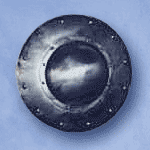
Rather than what we would term a buckler this appears to be a description of the Roman scutum, which was a shield used by the heavy-armed infantry, but the Romans did use a shield that was more deserving of the term buckler and this was called the parma. The parma was described by the Greek Polybius (204BC — 122BC) when commenting on the Roman army that he saw destroy Carthage and Corinth, in 146 BC. In his observations on the army structure he said, “The youngest soldiers or velites are ordered to carry a sword, javelins, and a parma. The shield is strongly made and sufficiently large to afford protection, being circular and measuring three feet in diameter” Excavations of examples of parma have shown them to possess a central umbo or boss and therefore could be said to be deserving of the term bocler. The term buckler has therefore been applied to many types of shield, but a defining characteristic, in the modern understanding of the phrase, is that they should be hand-held and not strapped or held to the arm. Further reason why
the buckler went out of use may have been both to do with the
law and fashion, for in England, in 1562, a statute was passed
by Elizabeth I preventing certain bucklers from being allowed
within the city of London stating as it did, “...neither
any buckler with a sharp point or with any point above two inches
in length, (shall be allowed within the city)
upon pain of forfeiting the sword or dagger passing the said length,
and the buckler made otherwise than is prescribed, to whomsoever
will seize upon it, and the imprisonment of his body that shall
be found to wear any of them, and to make fine at her Majesty's
will and pleasure.” In addition William Shakespeare (1564-1616)
illustrated the reputation held by those who used bucklers in
his play in Henry IV part II in the passage, which runs:
The reference of Shakespeare to the “swing-bucklers” is very close to another term which was associated with groups of such rowdy young men of the time: swash bucklers. This latter term arising, according to Thomas Fuller (Worthies III) 1662), “From swashing and making a noise on the buckler.” Various theories have this noise as arising either be from the sword clattering against the side of the buckler as they walked or from the fencer tapping his buckler with his sword prior to attack.
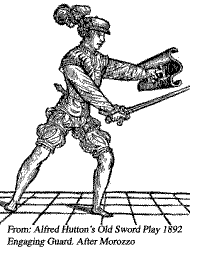
The buckler can be
held in many ways, but experience has shown that one of the most
effective stances to adopt is that recommended by Giacomo DiGrassi
as depicted in this illustration from his 1570 treaty - Ragione
di adoprar sicuramente l'arme si da offensa come la difesa; con
un trattato dell’ inganno et con un modo di esercitarsi
da se stesso per acquistare forza, giudicio et prestezza. This
illustrates that by holding the buckler out towards the enemy
the enemy’s lines of attack on the body are limited and
any thrust will be deflected around it. As DiGrassi himself says
“If a man would, that the Buckler work the said effect, to
wit: that it may be able with his smallness to cover the whole
body, he must hold and bear it in his fist, as far off from the
body as the arm may possibly stretch forth, moving always the
arm and buckler together, as one entire and solid thing, having
no bending, or as if the arm were united to the buckler, turning
continually all the flat thereof towards the enemy.” DiGrassi's methods
for launching attacks against a sword and buckler defence are
relatively simple, and vary according to the wards that the attacker
and defender are in, but a major component of a number of them
is for the attacker to make a half pace with the rear foot first
that is unnoticed by the defender (sometimes called a stealing
pace) and then from this position launching a thrust forward with
the lead foot. In some of the moves he advocates beating or holding
the defender's weapon away with the buckler, sword or both before
continuing to move in for a thrust with the sword, but, in practice,
it has proved wise to provide some barrier to the defender’s
sword in all attacks. In defence DiGrassi relies more upon voiding
of the body to counter the attacks rather than parrying with the
buckler, but in one section, referring to defending attacks from
the high ward, he says, “... it may easily come to pass that
both may approach so near one to the other, that he may with his
buckler give the enemy, the Mustachio, in the face.” The
Italian word mustaccio comes from the ancient Greek word for upper
lip or mustache mystax, therefore we can assume that this may
mean striking the opponent on the upper lip with the buckler rather
than just hitting them in the face. Although DiGrassi does recommend
their being some spike to buckler that could afford such accuracy,
practice has shown that lifting the buckler to strike the opponent
with its edge can not only deliver the same precision but it also
clears the way for a thrust to be made under the buckler with
the sword. There have been a number of reported duels with sword and buckler, but perhaps the most famous is that which took place between Guy de Chabot, the oldest son of the Lord of Jarnac, and François de Vivonne, Lord of Chastaigneraie, in the presence of Henri II on 20 July 1547. The duel arose as a result of Jarnac confessing to his friend La Chataigneraie that he was well provided for by his father's new young wife, who, loving the son better than the father, gave him as much money as he needed. La Chataigneraie did not hold this secret to himself and the rumour quickly grew that Jarnac was sleeping with his stepmother. In a rage Jarnac went to the court and in front of the Dauphin, La Chataigneraie and other courtiers exclaimed that whoever had asserted, that he maintained a criminal connection with his stepmother was a liar and a coward. La Chataigneraie stepped forward and said that it was Guy de Chabot, the Lord of Jarnac, himself who has said it and he would be willing to make him confess it again. The royal council then ordered that the matter should be settled by single combat - the matter not officially being over whether or not the Lord of Jarnac had slept with his stepmother, but over whether or not La Chataigneraie was lying when he said Jarnac had told him and boasted of it. The day of the duel came and La Chataigneraie, a strong man and a capable fencer, was confident, whilst Jarnac, who was slighter and more agile, but less capable, was not. The combat began and Jarnac was becoming overpowered by the strong blows delivered by La Chataigneraie, but La Chataigneraie had left his legs uncovered so that they would not be impeded in motion and when Jarnac feinted a cut to the head La Chataigneraie drew up his buckler and exposed his legs to attack. Jarnac covered his head with his own buckler and threw a draw cut with the false edge to the back of La Chataigneraie left leg, wounding him behind the knee. Distracted by this La Chataigneraie was unable to act quickly enough to prevent Jarnac executing a similar blow to the hamstrings of the right leg, which this time cut through to the bone. La Chataigneraie fell to the ground and seizing a dagger attempted to strike Jarnac, but he was unable to support himself, and fell into the arms of the assistants. Jarnac offered to spare the life of La Chataigneraie if he would admit that he had lied, but La Chataigneraie refused at which point Jarnac pleaded to the king, who was present, to intercede. At first the king refused but after the third appeal from Jarnac the king did stop the fight. However La Chataigneraie, humiliated by his defeat, refused help and, tearing off the bandages that the surgeons applied, died two days later from his wounds. Ever since that time the phrase “a coup de Jarnac” has been used to describe an unexpected attack and, in addition, this duel resulted in Henri II never again granting a field to duellists, which effectively stopped the legal duel in France. WELCOME | AIMS | DEMONSTRATIONS | GLOSSARY | SAFETY | JOINING | OFFICERS & MEMBERS | RAPIER COMBAT | Armour | Weapons | Rules | Authorisation | FEATURES | CONTACTS | LINKS |
||||||||

 The
ability to have an effective shield that was merely hand-held
arose from a change in the weapons they were combating and the
conditions in which they were used, because as the size of the
weapons began to decrease and civilian sword play became more
widespread the small, light buckler proved itself to be an extremely
effective parrying weapon in a fast-moving fight. This transition
occurred long before the dawn of the rapier, as is shown in the
13th Century treaty Ms I.33 that clearly depicts monks
using sword and buckler. This German document shows a pair of
fighters proceeding through a number of manoeuvres,
The
ability to have an effective shield that was merely hand-held
arose from a change in the weapons they were combating and the
conditions in which they were used, because as the size of the
weapons began to decrease and civilian sword play became more
widespread the small, light buckler proved itself to be an extremely
effective parrying weapon in a fast-moving fight. This transition
occurred long before the dawn of the rapier, as is shown in the
13th Century treaty Ms I.33 that clearly depicts monks
using sword and buckler. This German document shows a pair of
fighters proceeding through a number of manoeuvres, 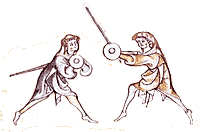 including
thrusts, cuts and disarms, in which the bucklers are frequently
held out at length from the body in order to close down the angles
of attack available to the opponent. The bucklers also vary in
type and although illustrations in period treaties are often misleading
it is obvious that some of the bucklers depicted in the treaty
are larger than others and that instead of rounded boss they possess
a pointed spike at their centre which can act as a further weapon.
Despite this ability to be used offensively the role of the buckler
has chiefly been considered to be defensive as is illustrated
by this section from A Display of Heraldrie, which was written
by John Guillim in 1610, “... And
it was ever held more dishonorable for a man to lose his Buckler,
then his sword in field, because it is more praise-worthy to defend
a friend then to hurt a foe, as a Noble Generall once said: Mallem
unum Civem, &c. I had rather save one good Subject, than kill
an hundred enemies.” It is clear then that the
buckler was in use from the 13th to the early 17th
Century and the majority of treaties on fence that span this period
include it as one of the weapon forms they discuss. Such treaties
include Talhoffer's 'Alte Armatur und Ringkunst' (1459), Marozzo's
Opera nova (1536) and Di Grassi's Giacomo DiGrassi His True Art
of Defense (1594), but by the beginning of the 17th
century mention of how
the buckler should be used in the sword fight begins to die out
and as early as 1578 John Florio, a friend of the English based
fencing master Vincentio Saviolo, derided the buckler as being
“...a clownish dastardly weapon”,
whilst in 1610 the treaty of Cappo Ferro, Gran Similacro dell'arte
e dell uso Scherma di Ridolfo Capo Ferro du Cagli, Maestro dell
ecclesa natione Alemanna, nell enclita citta si Siena, illustrates
the use not of the buckler but of a rotella, which is a larger
shield that is held on the forearm. The cause of the decline in
the use of the buckler was probably due to the sword becoming
much lighter than in earlier periods, which led to the gradual
replacement of left hand parrying methods as means of defence
with
use of the sword itself for this purpose resulting in a shift
of the fencer's body position from a forward to a more sideways
stance.
including
thrusts, cuts and disarms, in which the bucklers are frequently
held out at length from the body in order to close down the angles
of attack available to the opponent. The bucklers also vary in
type and although illustrations in period treaties are often misleading
it is obvious that some of the bucklers depicted in the treaty
are larger than others and that instead of rounded boss they possess
a pointed spike at their centre which can act as a further weapon.
Despite this ability to be used offensively the role of the buckler
has chiefly been considered to be defensive as is illustrated
by this section from A Display of Heraldrie, which was written
by John Guillim in 1610, “... And
it was ever held more dishonorable for a man to lose his Buckler,
then his sword in field, because it is more praise-worthy to defend
a friend then to hurt a foe, as a Noble Generall once said: Mallem
unum Civem, &c. I had rather save one good Subject, than kill
an hundred enemies.” It is clear then that the
buckler was in use from the 13th to the early 17th
Century and the majority of treaties on fence that span this period
include it as one of the weapon forms they discuss. Such treaties
include Talhoffer's 'Alte Armatur und Ringkunst' (1459), Marozzo's
Opera nova (1536) and Di Grassi's Giacomo DiGrassi His True Art
of Defense (1594), but by the beginning of the 17th
century mention of how
the buckler should be used in the sword fight begins to die out
and as early as 1578 John Florio, a friend of the English based
fencing master Vincentio Saviolo, derided the buckler as being
“...a clownish dastardly weapon”,
whilst in 1610 the treaty of Cappo Ferro, Gran Similacro dell'arte
e dell uso Scherma di Ridolfo Capo Ferro du Cagli, Maestro dell
ecclesa natione Alemanna, nell enclita citta si Siena, illustrates
the use not of the buckler but of a rotella, which is a larger
shield that is held on the forearm. The cause of the decline in
the use of the buckler was probably due to the sword becoming
much lighter than in earlier periods, which led to the gradual
replacement of left hand parrying methods as means of defence
with
use of the sword itself for this purpose resulting in a shift
of the fencer's body position from a forward to a more sideways
stance. 