Journal
of Western Martial Art
Clear Instructions to the Excellent Art of Wrestling,
Teaching how one can defend oneself in all occurrences of violence,
and how to counter all grips, pushes, punches &c.
Most useful against troublemakers and those seeking to offend others,
or that threaten one with a knife.
Developed by the very famous and well-known wrestler
Nicolaes Petter
With 71 new illustration engraved in copper by the artful
Romeyn de Hooge
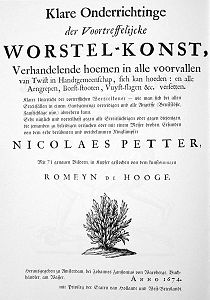
Reprinted in Amsterdam by Johannes Janssonius Van Waesberge
Anno 1674
with privilege from the states of Holland and West-Friesland.
Introduction to the English Translation
Anno 2000 © The Dragon Preservation Society
Prof. Sydney Anglo calls Petter's book "historically speaking, the most
important treatise on unarmed combat ever printed... the finest of all
wrestling books and deservedly the most famous" (the Martial Arts of Renaissance
Europe, p. 190). It was first published in 1674 and reprinted several times,
including one complete plagiarism. The combination of Petter's lucid descriptions,
devoid of all jargon, and de Hooge's masterful depiction of pain and violence
in the engravings, elevates the book to its position of solitary eminence.
It is also probably unique in presenting an effective and complete unarmed
combat system in a format from which it would be actually possible to learn.
This translation is based on the version included in "Chronik alter
Kampfkunste", Weinmann, Berlin, 1997 [isbn 3 87892 031 8]. This version
has only a German translation for the preface and address, and I don't
know how close this is to the original. The first half of the German preface
is also quite obscure. My rendition should thus not be considered as an
exact translation of the original.
The actual technique explanations are translated from the original Dutch.
In the original they are not, by the way, in verse. Many of the phrases
used in the book can be rendered in a lot of different ways. Where alternatives
are possible, I have chosen one that seems to make most sense in the context
of the illustrations. I have sometimes restructured sentences whenever
I felt it necessary for clarity, but have tried to stay as close to the
original as possible (as the effect is often quite humorous). I have taken
great care not to "improve" on the original, and where I could not keep
from adding information, this has been indicated by a note. Notes are enclosed
by square brackets [like this].
The original groups the captions by chapter, separate from the illustrations.
Here each plate is placed under the corresponding explanation.
About the translator (Eli Steenput): I started practicing martial
arts in 1992, and hold some dan ranks in Chunen Butori Ryu, Iaido and Aikido
as well as an HB rank from the soke of that art. During the last couple
of years I have also been interested in the study and reconstruction of
old European martial techniques. Besides this and being a native speaker
of Dutch, I have no qualifications for translating Petter's book. Actually
I started on the translation thinking there was none available in English
(and that it would thus bring me fame, wealth and the adoration of millions).
As
it turns out a different translation of Petter is available here,
which I found after almost completing my own. As no single translation
can ever do full justice to the original, I encourage the reader to compare
both translations whenever a section is unclear.
I dedicate this translation to all those who have so generously taught
and continue to teach me their arts. My URL: http://www.geocities.com/ulfberth/
PDF Download here
Preface
The wisdom of the sharpest minds of this or past centuries, no matter how
admired they may be, would be soon lost, were it not for Writing. On the
other hand, practical experience and inventive study by a smart intellect
have given many new insights to this world.
Practice perfects knowledge! It is not enough to understand matters
with a quick mind, only one who has practiced will be able to apply his
knowledge. There must also be instruction to make an art known to others,
without which it would disappear with him that invented it.
Time, dedication, practice, and a quick mind are beneficial to give
this art its own life and also some finesse. The ever active intellect,
if it has been developed by continued practice and dedication, will give
its owner much joy and support.
Apelles could, only because of his trained mind, imitate nature with
paint and brush so well that it seemed nature itself had borrowed the shapes
of things from Apelles. Another artist will control his chisel with his
trained mind, to form stone in shapes for which nature should not be ashamed.
Indeed it would seem that while nature always strives for perfection, it
is in art that we see it more often displayed.
It is not my intention here to disparage nature, whose manifestations
fill us daily with wonder and amazement. I intend rather to represent the
actual character of an Art and to promote the reverence for her. In addition
I want it to be examined by everyone- the diligence and interest of everyone
should therefore be excited.
The forces which were lent to the human understanding by nature, are
not present alike in each art, and even if they were, then they would nevertheless
not be developed in the same way. Of two arts one is usually superior,
this is in general the one based on knowledge.
Most people do not seriously consider how they could secure themselves
against all manner of abuse or assault, as might be leveled against them
by evilhearted villains, eager for violence.
Our wrestler has studied this problem, first developing his mind, then
looking for effective strikes and holds, by which one can defend against
violent attacks with shoves, punches or a knife. These he has practiced
diligently, and, to benefit the community, he has decided finally to compile
this instructional book on the art of wrestling. Cruel Death has untimely
taken him from us, before he could bring this project to conclusion. The
images had already been prepared during his life, ordered and provided
with explanatory captions to instruct the studious wrestler.
Therefore we no longer want to keep this excellent and useful art from
the world, particularly since many enthusiasts have insistently requested
its publication. We want to publish this also for the benefit of the world,
in that it may help check criminal violence.
Receive therefore this new, outstanding and useful art, of which no
man should remain ignorant, with friendly thankfulness. Study the techniques
diligently, and practice them. You will never regret the effort, on the
contrary, you will enjoy many good fruits from your labor, you will be
able to easily discourage and reduce aggressive behavior, and thus even
those ignorant of this art will benefit, as they too will be able to move
about in peace and unmolested.
To the Wrestling Enthusiast
Honored reader, this art is here presented in such way that everything
you may want to know about it, is duly described. You find here a very
clear ordering of all body parts. Which technique is appropriate for a
given attack, follows from the ordering of the illustrations, and so nobody
would confuse the fighters drawn, they are marked A and B, B and C, C and
D, and so on. And because variation is always pleasant, so sometimes A
will be the victor, and sometimes B. The different clothing worn by the
fighters shown on the plates, will also help to distinguish them by their
appearance, as will be noted by the attentive reader.
Those wanting to experience this art in reality, or wanting to receive
personal instruction, can contact Nicolaes Petter's student Robert Cors,
who has practiced all techniques many times with the master. He is prepared
to instruct interested parties in these techniques for reasonable remuneration.
He can be reached at the Witwe house of Nicolaes Petter on the Prinsengracht
in the Gustavusburgh not far from the combat academy. There all lovers
of this wonderful art will find such complete joy, that they will feel
indebted forever.
Use this art to your advantage, but may you always gratefully remember
the one that gave this art to you. Then the future will see others, who
by their trained mind will continue to enrich the art with new techniques.
Live well!
Clear Instructions to the Excellent Art of Wrestling
It is common, particularly in Holland, that when an argument escalates
to violence, people will start pushing the other on the breast, as the
first step to fiercer blows. So we have started with the breast-shove,
it being the usual start of the scuffle, and so we will deal with other
grips in their due order. [I don't know an exact English equivalent of
'stoot', but the meaning here is a violent push or shove rather than a
punch.]
The First Part
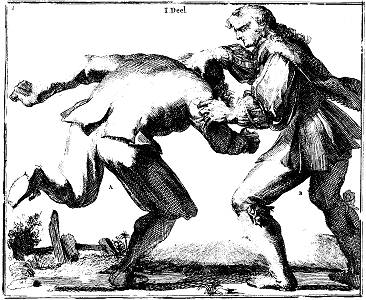
N°.1. On the breast-push
When A wants to push B, B can move aside a little to make A miss him. Having
missed, A will stumble forward, which allows B to grip A behind the neck
and push down, forcing A to fall forward.
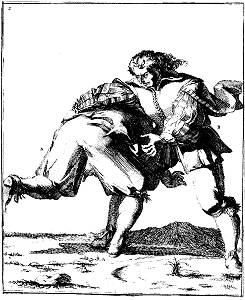
2. Breast-push in another way
A pushes B, B receives the push so that, when it comes, B throws [literally,
'slings'] his left or right leg before [or 'around' as alternative translation,
but that doesn't match the plate] the left or right leg of A, and pushes
with the left hand down on the right arm of A, and B grasps with the right
hand the seat of A's pants, so A is forced to fall over the leg that B
has advanced.
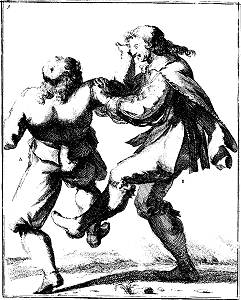
3. In another way
A pushes B, B, seeing this, grabs the right arm of A with his left hand
under the armpit, and with his right hand grabs the left wrist of A, and
quickly strikes up [literally, 'around'] the right leg of A with his left,
forcing him to fall backwards.
4. In another way
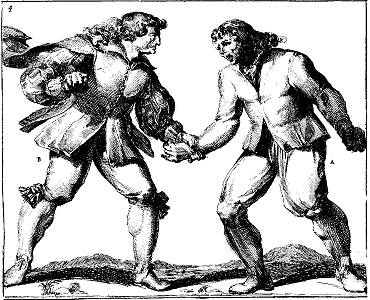
A pushes B, B grabs the wrist of A and with exceptional force tries to
twist his arm.
5.
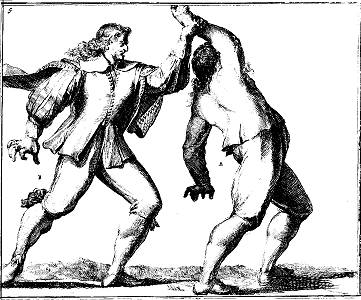
To counter the previous, A moves ['crawls'] under B's arm in an attempt
to get away ['seeking to get loose'].
6.
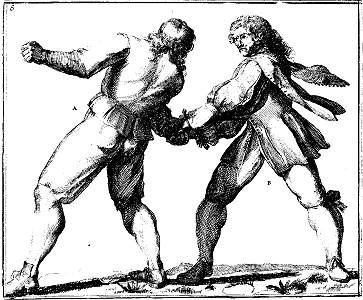
During the previous, as A is trying to move under his arm, B immediately
grasps with both hands, the hand of A which he had previously gripped at
the wrist with his left hand, and forces it behind the back of A, which
gives B the opportunity to break A's hand.
7. A counter for A
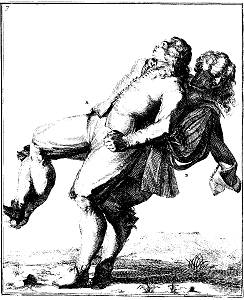
A steps backwards and places his right leg around the right leg of B, after
which he leans backwards, so both will have to fall, and A can get out
of the hold.
8.
So they are fallen, because of the leg of A around the leg of B.
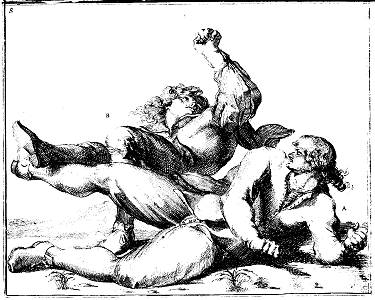
9.
The one that rises first has the advantage, that he can grab the other
by the neck with the left hand, and by the pants with the right hand, and
so force him to walk forward.
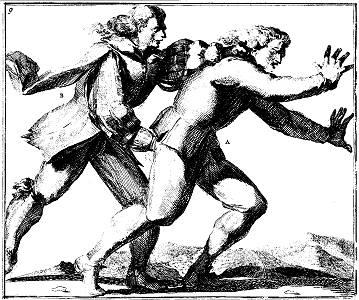
10.
As B did the previous, so here A has countered by throwing his right hand
back and grabbing the right wrist of B, turning around under his arm.
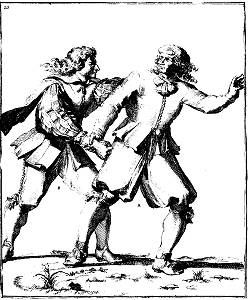
11.
Having turned under B's arm, A pulls B's arm down, places his left foot
on the back of B's knee, and pushes him with his head, so he must fall
backward as shown in the next plate.
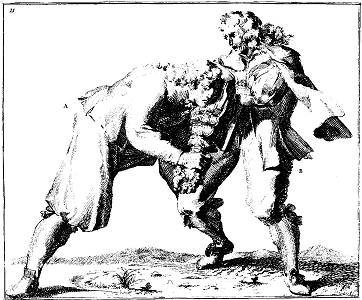
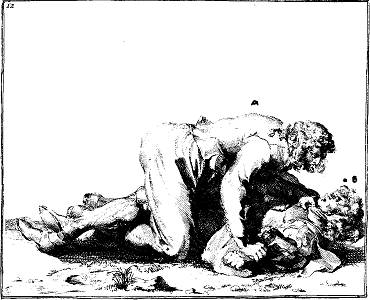
12.
Thus being thrown, and A being on top of B, grabs his throat with the left
hand, keeping the right arm pinned against his breast [with his left forearm].
With the right hand A holds the left hand of B to the ground, holds his
legs with his own, so B is prevented from getting up, and A, thus being
positioned, can give B, without obstacle, with the side of his head, as
many blows to the face of B as he desires.
The Second Part
N°. 1. On the Breast-Push
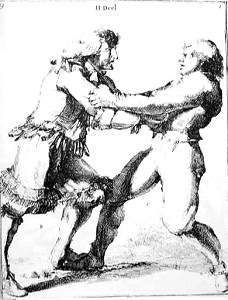
As in the beginning of the first part A pushes B with one hand, so in this
part B will give the push on the breast of C with both hands, and places
his left foot on the right foot of C. C immediately grasps B's arms or
sleeves close to the armpits.
2.
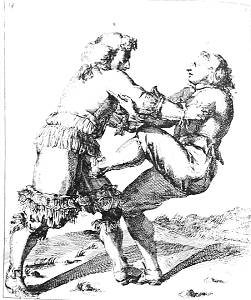
C having thus gripped B, places his left foot on the middle of B's body.
3.
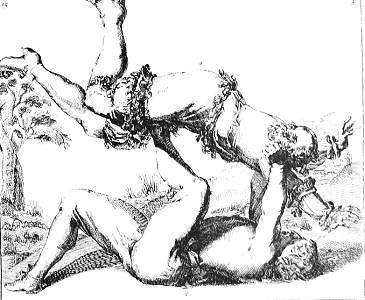
Having placed his left foot thus, C throws himself backwards, such that
B, being held under the arms, and with the foot of C on his body, is forced
to fall over C.
4.
But if this technique ['greep'] used by C is known to B, feeling that C
wants to fall, so B strikes his arms loose from C going over and outside
C's, and grasps the foot of C, which was placed in the middle of his body,
and holds it with his right hand at the toes and with his left hand at
the heel of C, and so twists the foot of C as if he wants to break it to
pieces, which will cause considerable pain and helplessness to C.
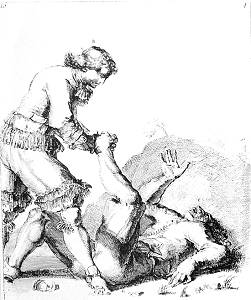
5.
But against the previous we can here clearly see the counter for C, when
B is, as was previously seen, twisting the leg of C. To counter this twisting,
C throws his right leg on the left arm of B with such force that B loses
hold with his left hand, but now B saves himself by dropping down on C
and grasping C by the throat, and forces the left leg of C, of which he
previously twisted the foot, over to the inside, and grabbing with the
left hand the right arm of C, so C is made powerless.
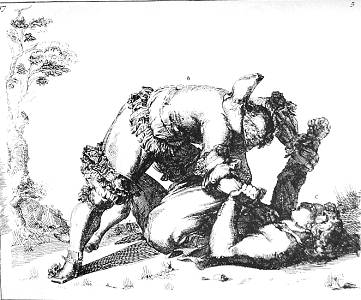
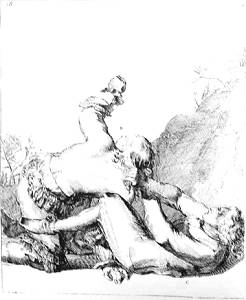
6.
C can however counter thus, by kicking the left foot of B with his right
leg, and twisting his right hand free against B's thumb, so that B is forced
to fall. As B falls, C grabs him by the hair and so throws him to the ground.
The Third Part
On the middle grip
After the breast-push follows the middle [or waist] grip, which
is shown here as follows.
1.
C grips D with both hands around the middle. D being thus grasped by C,
places his left hand on the back of C's arm, and placing his right hand
on C's face with the thumb under the nose, D forces the head of C backwards,
and throws his right leg around the left leg of C.
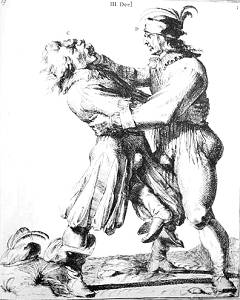
2.
Against the previous, C can counter by throwing his left hand inside over
D's arm, and turning it aside, can free his face while D maintains his
hold on the right arm of C.
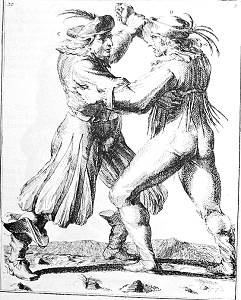
3.
As D is now holding C by the arm, D twists his right hand free, and turns
around and behind the right arm of C, forcing C to advance by pressing
his elbow against the weak part of C's back, thus controlling his arm.
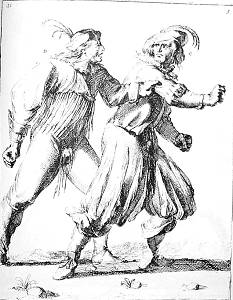
4.
C's arm does not stay controlled for long, if he turns a little, and throws
his right arm over and around the left hand of D, locking it close against
his body, and by then turning with the entire body, it can happen that
D's hand would be broken.
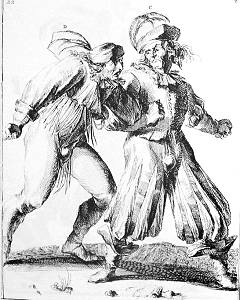
5.
To prevent his left hand, which is now so twisted, from being broken, D
grasps with the right hand the right wrist of C, and with the assistance
of his now freed left hand, turns around, holding on to C's hand with both
hands. In this turn C brings D's right arm on his left shoulder, pulls
forward with all his strength, which causes C much pain, and offers D ample
opportunity to break C's arm.
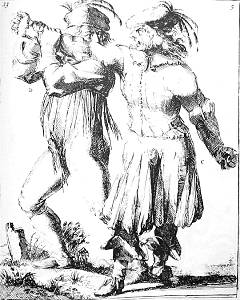
6.
This opportunity is taken from D when C puts his left hand on D's left
arm, and places his right knee on the lower back of D, thus forcing him
to let go of C's arm.
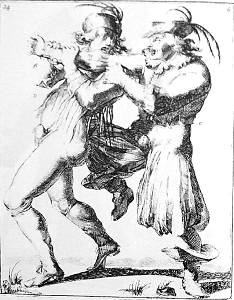
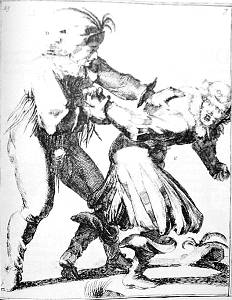
7.
This does not cause D to lose courage; having let go the right arm of C,
he grabs it again with his right hand, and turns around, twisting with
both hands the hand or arm of C, pulling it towards him with the right
hand, and placing his left hand on C's shoulder, pushes him forward, forcing
him to fall.
The Fourth Part
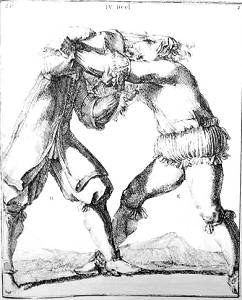
N°. 1. On the Hair-Pulls
This shall show us nothing else than how these grips are begun, with D
grasping the hair of E between his fingers and twisting it around them,
having extended his arms inside between the arms of E.
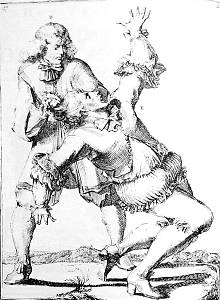
2.
Then D pulls E backwards by the hair, turning him around, placing his elbow
on his spine, which allows him to strike E on the face from behind with
his other hand.
3.
E being inconvenienced thus, still being held by the hair, D [It is not
completely clear from the text who does the turning, but E already has
his back towards D] turns around so that D and E are back to back, D then
places his behind against the behind of E, and pulls him with great force,
as a result of which E will fall over the head of D.
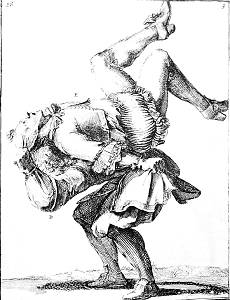
4.
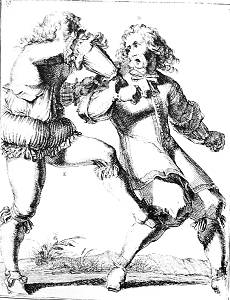
E being thus overturned and thrown, does not stay down, but standing up,
grasps D behind the sleeve or arm, and grasps with the right hand the right
wrist of D, forcing this grasped arm of D inwards, and places his left
foot on the back of the right knee of D, thus forcing him to fall (though
the plate does not display this fall).
The Fifth Part
On techniques wherein one's strength is used to defeat the other
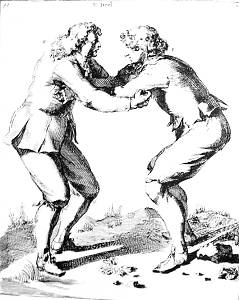
N°. 1.
E grips F under the arms, and F grips E inside his arms, in this situation
E appears to have the advantage.
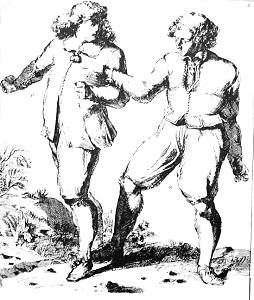
2.
But F strikes with his right arm on the inside of E's left arm, breaking
his hold, and his hold being broken, lets go with his left arm as well,
and brings it in front against his body, pinning the right hand of E with
his left arm. Then he turns away a little, so the hand of E is squeezed,
and F has the opportunity to break E's hand. As the plate shows, he suspects
a legsweep from E.
3.
For this reason he lets go of F's arm, and turns around completely, through
which he achieves that E will not be able to escape a blow to the neck,
although E grasps the pants of F with his right hand.
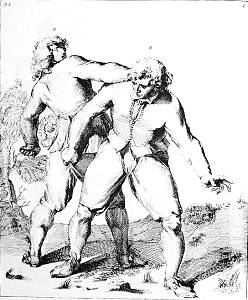
4.
E is not too proud to bend forward under the blow of F, and F, striking
with full power to the neck of E, and missing this because of E's bowing,
strikes himself down through his own force.
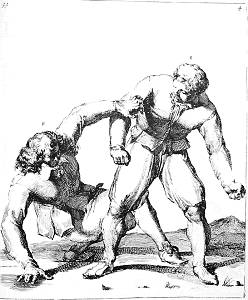
5.
Thus falling, F supports himself on the right hand, with which he had wanted
to strike, and thus supported he quickly places the left knee to E's hindquarters,
grips with his left hand the other's left foot, and pushes him over with
this knee.
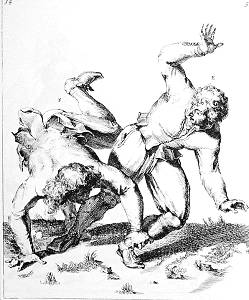
The Sixth Part
N°. 1. Of Two Breast-Holds
The first breast-hold is with F grasping G on the breast, and G grasping
him with the left hand under the arm above the elbow.
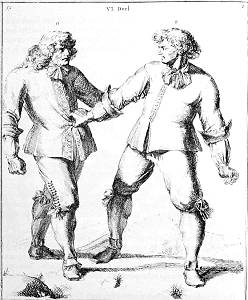
2.
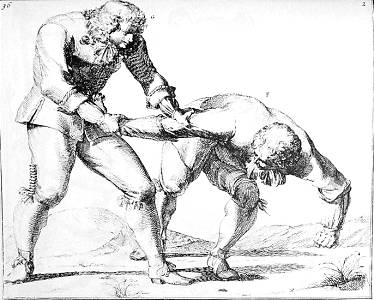
But F having thus gripped G, G slaps his right hand on the right hand of
F, and twists this hand until F lets go of his breast, G now having his
breast freed, twists the right arm of F completely around with his right
hand, placing his left hand on the back of this same arm, thus forcing
him down.
The Seventh Part
On the Breast-Holds in another way
In this part the breast-holds are countered in an entirely different way,
for which reason this part is separated from the previous one, as in the
previous part the hold is forced loose by a countergrip, and here it happens
as follows.
1.
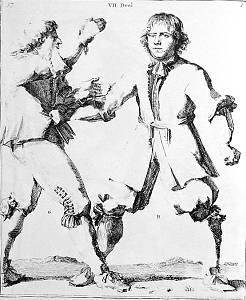
H grasps G on the breast, G strikes with his left hand the hand of H loose
from inside his arm, and grasps with the right hand behind the sleeve of
this arm that was struck loose, and so this hand is removed from his breast.
2.
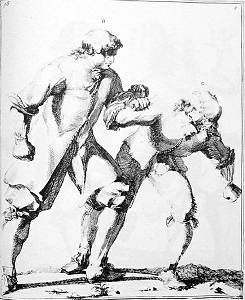
H brings his left hand inside his arm that was struck loose, and turns
away a little, so he now stands partly behind G. Having taken this strong
position, H can force G to fall forward or otherwise as pleases him.
3.
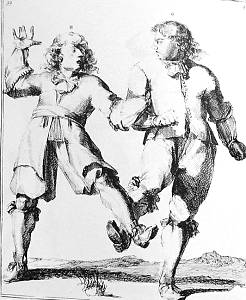
G realising that he must fall forward, strikes up the left leg of H with
his right leg, so the lock by H's hand looses its power, and is instead
caught by G in the bend of his right arm. H being thus controlled is in
serious danger of having his squeezed hand broken.
4.
To avert this imminent disaster, G gives H such a push with his leg, that
he can quickly grasp G outside his arm, with his right hand on top of G's
arm and his left hand under his elbow, thus forcing him backward. In this
way the legsweep by G, that would have dropped H, is neutralised.
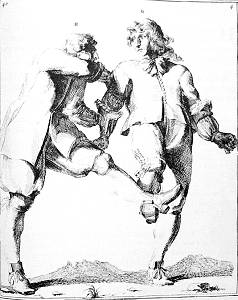
The Eighth Part
N°. 1. On the Fist-Punch
[Note: I was replaced by J to avoid confusion]
H and J both have assumed postures to punch each other with the fists,
inside the arms, and standing thus, (though this is not shown on the plate)
one could give the other a leg-strike [the meaning here might be a sweep
as well as a kick] so that the one receiving that strike would have to
fall.
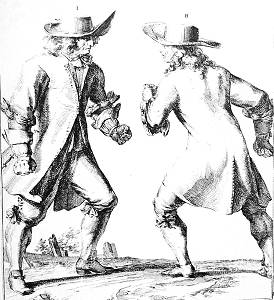
2.
H punches J, but J seeing this bends down, so that H punches himself off
balance, and at this point J grasps the right foot of H, to throw him.
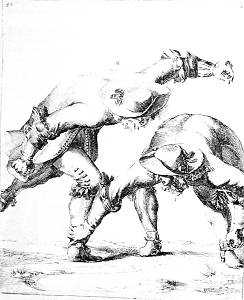
3.
H feeling himself fall, pushes J with his right knee against the thigh,
so J is also forced to fall. In this fall H also tries to grip the left
leg of J, but is unsuccessful.
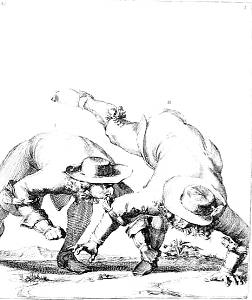
4.
H and J are both again standing, now as if to punch outside the arms, so
H first punches J, who at once grasps the striking arm behind the shoulder
with his right hand, and with the left hand J grasps the right leg of H,
forcing him to fall. This throw by J can be performed in another way, as
seen in the next plate.
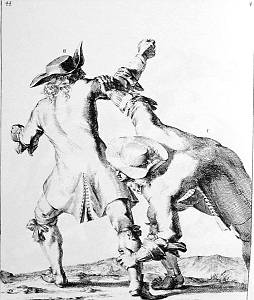
5.
J throws H, holding the arm he grasped, and pulling or pushing him around
a little, grasps his left shoulder with the left hand, places his left
knee on his back, and so bends him backwards, forcing him to fall.
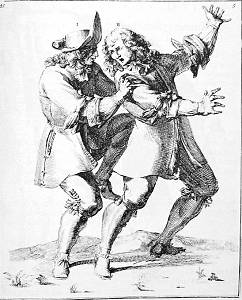
6.
To avoid this throw, as J has placed his knee on the back of H (as shown
on the previous plate), so H must, by twisting his shoulders, free himself
so he can grasp one or the other hand of J, whichever has released its
grip, and holding this (on the plate it is the left hand), turns it behind
the back of J, and placing his other hand on the twisted arm, H can throw
J, or at least force him to fall.
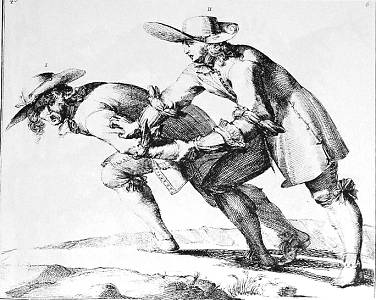
The Ninth Part
How someone, being in a fight with another, can be carried off.
These techniques offer sweet pleasure to any who see them executed, and
being both amusing and amazing, these instructions deserve special attention;
as the result is carrying off someone who is most often in great rage against
the one he was fighting, yet for all his anger must suffer himself to be
carried away helpless. This trick has often been carried out by the author.
[this pun is not in the original]
N°. 1.
J and K are ready to come to grips, K threatens J with a punch, then J
grasps with his right hand the left wrist of K, bends down and puts his
left hand behind the knee of K, and pulling the left arm of K over his
shoulder, he can carry him to wherever he wants him.
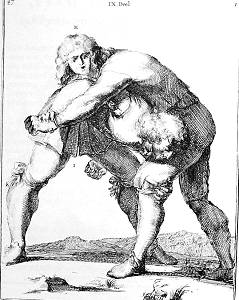
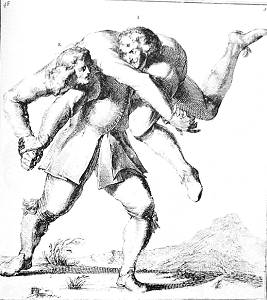
2.
If K doesn't see it coming, he will be lifted on J's shoulder, and he can
be carried of easily, even if he is bigger and heavier than J.
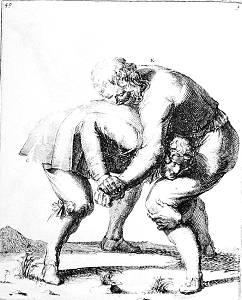
3.
If K knows this trick, he will push down on the head of J, making it impossible
for J to lift him.
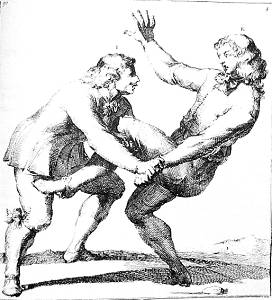
4.
J feeling that is head is pushed down, pulls the left hand of K to the
outside, and pulling back his head, lifts with his left hand the left leg
of K, and throws him on the back.
The Tenth Part
On Throat Holds.
These grips are handled entirely different from the breast-grips, which
were dealt with in the Sixth Part.
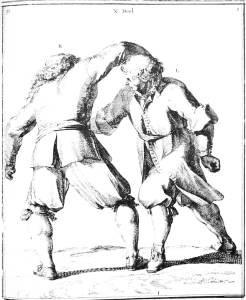
The first Throat-hold.
K grips L by the throat, and L, throwing off his hat, turns over his head
to the outside, under the arm of K, so the hand of K is twisted such that
he is unable, despite great pain, to apply force with it.
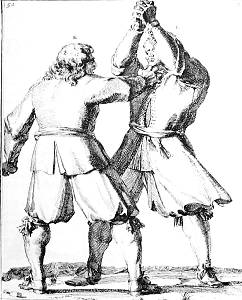
The second Throat-hold.
K grips L by the throat with the right hand, threatening to strike L with
the left hand, feeling this, L throws up both arms, and strikes the same
on the upper part of K's arm, forcing him to release his hold.
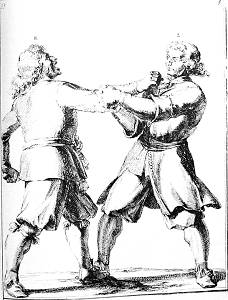
The third Throat-hold.
K grips the throat of L, as in the previous plate. L again joins both hands,
and strikes sideways against the elbow of K, breaking his hold.
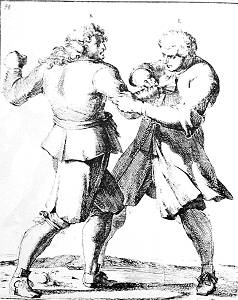
The fourth Throat-Hold.
K again has L by the throat, who grasps K's attacking arm with both hands,
placing the right hand on K's wrist, and the left hand behind the elbow,
and bends the arm to the inside [it's not clear from the text who this
arm belongs to, but I believe it to be K's] in such a way that it becomes
almost impossible for K to free his hand. If L succeeds in breaking the
grip of K, L will place this loose hand of K against his own breast, and
strikes up K's foot with his leg, or strikes K's manhood with his knee,
which could inconvenience him considerably.
The Eleventh Part
On the defence against a Knife being drawn
Unreasonable and reckless rogues, whose heated brain is not to be calmed
by reason, expose themselves easily to the gravest danger, as they consider
no argument, no matter how insignificant, can be settled without the drawing
of a knife, which is extremely dangerous. The peace-loving could guard
against this in the following way.
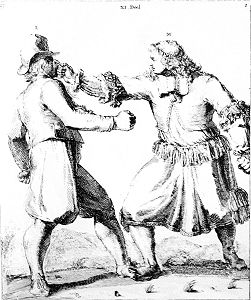
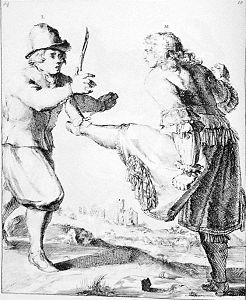
1.
M here kicks L with the left foot first, and then punches his face with
the right fist. [Here the text and drawing don't seem to match; M is standing
on L's left foot with his right. From what follows, the idea here is probably
to act decisively before L is able to draw the knife.]
2.
L reaches for his pocket to get his knife and draw it; thus withdrawing
his right hand from his pocket, holding the knife with it, M will insert
his left hand under L's arm while he is withdrawing his hand from his pocket,
and twists with his arm the other's arm backwards, which renders him powerless
to draw his knife. [As the next technique shows, the knife is considered
here to be still in a sheath.]
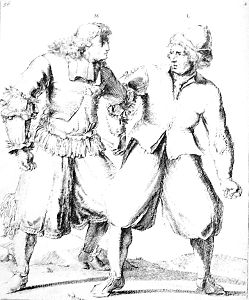
3.
In case L is faster in getting out his knife, then M is able to prevent
it in the manner described above, and he consequently is about to draw
it, so M grasps the right wrist of L with his right hand, and with his
left hand a little higher on his arm, so he can completely twist L's arm.
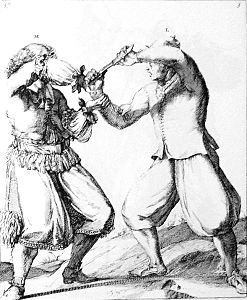
4.
M here completely twists L's arm, and places it on his shoulder.
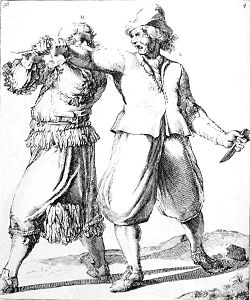
5.
To break the hand in which L is holding the knife, M brings the arm over
his head to his other shoulder, where he can break it more surely [could
mean the position is more secure, or makes it easier to break the arm -
or both].
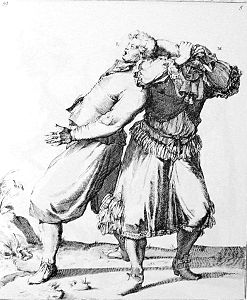
6.
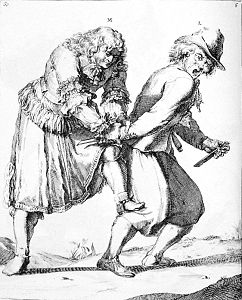
M can also, from holding L's arm as shown in N°. 3, force it on L's
back, and put his left foot on the back of L's knee.
7.
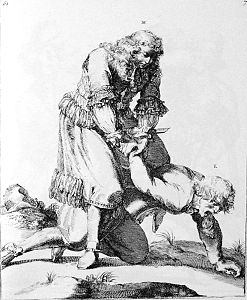
M having placed his left foot on the back of L's knee, pulls the arm he
is holding a little higher towards himself, and forces L to drop forward,
placing then the left knee on his back, and pulling the arm even higher,
L is rendered completely powerless.
8.
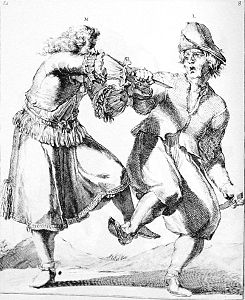
Again from the third plate, M can, with his right hand on the right wrist
of L, and his left hand a bit higher on his arm, force L's hand towards
his own breast, and simultaneously striking the right leg from underneath
him with his left foot, throw L backwards, and following through, can make
L wound himself with his own knife.
9.
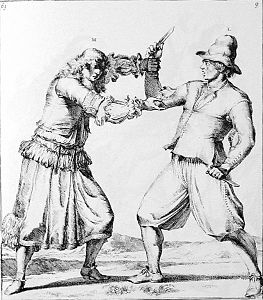
If L, having drawn his knife, wants to cut at M from above, so M will grab
him at the wrist with his left hand, and at the same time grabbing him
under the elbow with the right hand, he can twist the arm outwards, and
so render L helpless.
10.
If L still wants to cut from above, M can, from a solid stance, kick with
either leg under the joint of L's hand [there is no apparent reason for
this rather curious term for the wrist in this instance], sending the knife
flying from his hand.
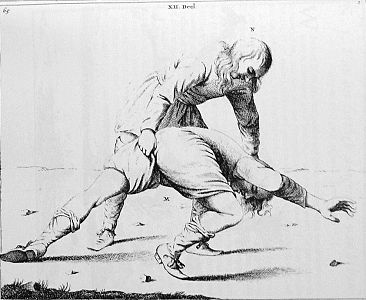
The Twelfth Part
N°. 1. On running with the head against someone, and throwing him over
the head.
If M and N are facing each other in position, M can lower his head and
by running at N butt him powerfully in the stomach, throwing him flat on
his back: but N, perceiving his intention, turns aside a little, so M misses,
and N has the opportunity to place his left hand on M's neck and grabbing
his pants with the right hand, driving him on a little to make him fall.
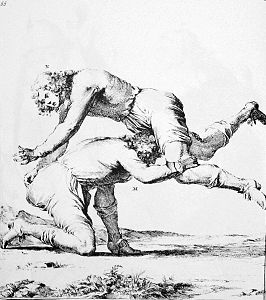
2.
If M runs at N with his head lowered, he can drop on one knee, at the same
time grabbing him strongly with both hands behind the knees, and then raising
his head, he will be able to throw N lightly over himself.
The Thirteenth Part
N°. 1. On strongly gripping Shoulders and Neck, with Leg-sweeps.
When N and O have gripped each other at the upper part of the arms by the
shoulders, they both wrestle to weaken the other above, then seeking the
legs below, and if N through greater strength is able to bend O over to
the side, he takes this opportunity to sweep the right leg of O with his
left foot. [The layout inconsistency here is also in the original]
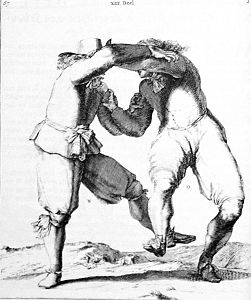
2. But O is expecting this, and raises his leg so N's foot misses and
passes under it, upon which O places his raised foot behind the leg of
N, of which the foot tried to sweep him, as then he has a chance to sweep
this, and throw N down.
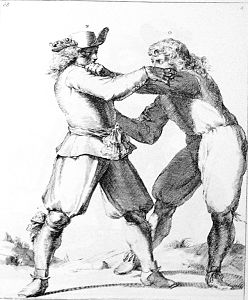
3. This N will prevent by letting go of O's arm with his right hand,
and grabbing the left shoulder with it inside the arms, then quickly throwing
his left arm around O's neck, forces him down, having placed his left leg
behind the same leg of his opponent, thus pushing him backwards.
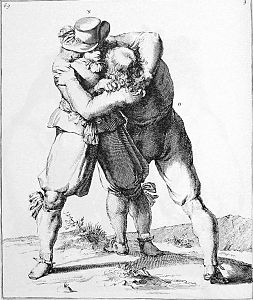
4. As O feels that he can not remain standing, lets go completely his
left hand from N's shoulder, and with his right hand lowered to the hips
of N, he drops down on the left knee, and grasps with his left hand the
lower leg of N, above the right foot, and holding this, throws him by pushing
back his upper body with the right hand.
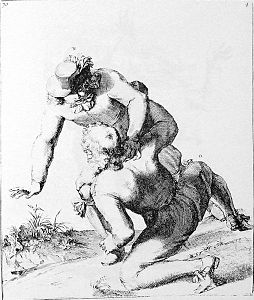
5. This last technique is special, in that it allows one to quickly
throw ones opponent without effort; here O, standing close to N, strongly
places his left foot behind the left leg of N, and quickly grabs his throat
over his arms, throwing him grandly on the back.
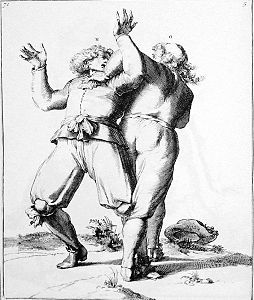
EYNDE.