|
It is very largely owing to the influence of the school of Angelo that there has always been a faithful few who "bent the knee" and kept up the cult of arms. The very outside alone of the elder Angelo’s sumptuous “L’école des Armes,” published first by Dodsley in London, in 1763 (from which edition the references in this paper are taken), and afterwards translated into English, proves that the position which fencing then held in the beau monde was high enough to carry off the gallant bravery of its attire. The large clear type and spacious margin, the rare excellence and profusion of engravings by the best masters of the time, and the representative list of the subscribers, lords and divines, men of arms and pedagogues, all go to show a general and lively interest in the art. Fencing, in the present restricted meaning of the term, is no longer used to describe the methods of handling swords that could be used either for cutting or thrusting, but is confined to the management of the point. Among the early Italian masters, however, and in England during the sixteenth century, the weapon in use was a heavy rapier with a long two-edged blade, generally adorned with an elaborate hilt. The fencers of this time accordingly neglected the conduct of the point, so that, as was natural with a cumbrous blade, their defense actions aimed rather at strength than at speed. The play of our forefathers was as wild and imaginative as the adventurous spirit of Elizabethan England. The followers of quaint Euphues, with his subtle coinage of conceits, would have expressed their fancy on the field with sword, just as with tongue and pen in the precincts of the court. During the following century, as the superiority of point over edge was little by little recognized, the old fantastic play was sobered down; and after the introduction of the light fleuret, the ascendancy of the point was complete. The fleuret or foil, with its flexible quadrangular blade, about thirty-four inches in length, is the substitute in the fencing-room for the “épée de combat,” the present representative in France of the small-sword, with its elegant triangular blade, grooved between the edges, which superseded the rapier. |
||||
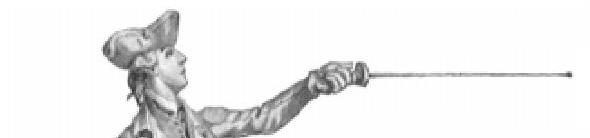
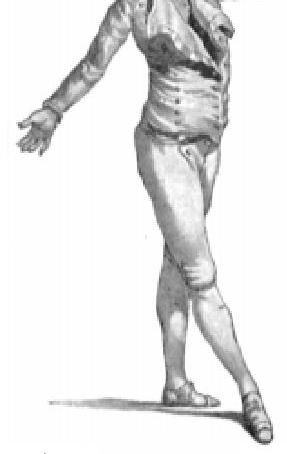 THE old style of fence,on some of the most marked characteristics of which this paper touches, is not so very old, dating only from the latter half of the last century; and yet, by reason partly of this very nearness in by H. A. Colmore point of time, the differences between the old and new strike one with the greater force. In Angelo’s treatise on fencing, which is here used as a milestone to show how far and in what direction later masters have travelled, some of the most pronounced and extraordinary attitudes appear for the last time; and even then certain of the masters were beginning to protest against them. I have selected Angelo to illustrate the