1. Halliburton, Richard. Seven League Boots, Indianapolis: Bobbs-Merrill Co., 1935; p. 214 f.
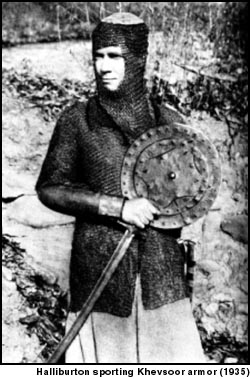
2. The photo of Halliburton shows him posing in mail shirt with buckler, and a 19th-century Mameluke-style saber. Other fighters carry regionally made weapons of the qama and Kindjal patterns. This hodge-podge of styles is to be expected from a tribe without more than basic metalworking capabilities.
Sword and Buckler Fighting among the Lost Crusaders
When the 20th century kicked off in Europe, there remained pockets of backward populations virtually untouched by industrialization and the advances in communication. Some of these isolated sub-cultures still retained traces of fighting systems that even the great cultural levelers of the century, Communism and Fascism/Nazism, required decades to eradicate.
A the fringes of civilized Europe, in the ranges of the Caucasus mountains, the American traveler Richard Halliburton (1900-1939) heard a curious tale in 1935, when he visited the city of Tblisi in the then Soviet republic of Georgia.
Georgia on my mind
In 1915, a year after the outbreak of World War I, the citizens of Tblisi woke up to watch a troop of mounted warriors ride down the cobble-stoned streets. They were armed with rusty chain armor, sword and buckler, and carried rifles of amazing antiquity. They called themselves the Khevsoor. Their mission: Upon learning that their Czar was at war, they wanted to put their swords at his disposal.
These men hailed from remote region of the Caucasus–and area cut off from the outside world by ice and snow for a full nine months out of each year.
The Khevsoor considered themselves the direct descendants of a party of crusaders who got separated from a larger army and got stranded in this remote area. Indeed, Halliburton believes to have recognized French and German fragments in the otherwise unintelligible dialect of the people.
Legend of the Lost Crusaders
It remains unclear what crusade brought on the unfortunate exile...if a contingent of fighters indeed made up the entire original land-wrecked party, or if only a handful of men was accepted into an indigenous population. There's no record on the social status of these men... if they were knights, common soldiers, or maybe just entourage. Indeed, since the very existence of these people currently cannot be corroborated, it is tempting to write the whole story off as a hoax, at best to colorful local mythology.
But Richard Halliburton's works exhibit little creative imagination. And since his is the only published account of a westerner having visited the region and observed some of the more picturesque traditions, I am tempted to believe at least the description of what he witnessed1:
On first reaching the land of the lost Crusaders, I had hoped to find every man wearing his famous coat of mail. I didn't find a single one. Instead they all wore a homespun cross-embroidered shirt over baggy trousers. But on the wall in every house, the armor hung beside the shield and gun. The sword itself, varying from twelve to thirty inches in length, each man carries constantly.2 It is as much part of his dress as his sheepskin hat, or the ornamental row of cartridges across his chest.Seeing how interested we were in the chain armor, the village elders took half a dozen suits and let me examine them and try one on. The entire outfit, including shield and sword, weighs about thirty pounds.
Each mesh coat is made of some twenty thousand tiny iron rings and goes on like a night shirt. The sleeves are short, but mesh gauntlets cover the forearms. With each suit goes a bag-like chain helmet with a hole cut out for the face. A flap folds over, so that the entire head can be protected. For the shins there are likewise mesh greaves. Consequently when completely arrayed, the only parts of the body vulnerable are the knees and thighs. The original mesh is terribly rusty, as the owners no longer understand how to preserve it. The newer coats are made from copper wire stolen from the telegraph line along the highroad. It is both cleaner and lighter than the iron but offers by no means as good protection.
The Khevsoors have not worn their coats of mail into battle since their famous march into Tiflis in 1915. The chief reason is that those who finally did join the Czar's army found that modern bullets have no respect for copper wire mesh.
But for duelling, which remains an accepted way for settling all disputes, the contestants still clothe themselves in their armor. Also they enjoy fighting for fun. Like their forefathers, the Crusader knights, they have a passion for putting on their iron shirts and going at each other with broadswords. Fighting, both in good and bad humor, in this land where books are unknown and where other forms of sport or diversion simply do not exist, is the only means they have of expressing themselves.
Sunday is reserved for getting drunk and duelling.
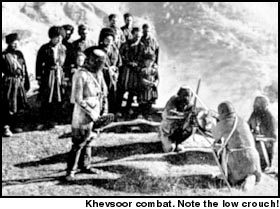
For our benefit two of the Khevsoor braves decided to put on a show. We all went to a little plateau outside the village where the duellists faced each other. There is no referee, as everybody has known and followed the rules for centuries. Unlike the jousting in the Middle Ages, when ladies were such important features in the tournament, the Khevsoorian duellists permit only men to watch. However, there is an age-old custom that permits a woman to stop a duel at her pleasure by appearing on the scene and tossing her handkerchief between the two combatants.
The fighters crouch with one knee bent almost to the ground. Their small round shields, embossed with a big cross, are used to parry rather than receive the blows of the opponent's sword. The duellists jump about with astonishing agility, circling and jockeying for position like fighting cocks.
Recklessly, the swords thud on leather shields, crunch on chain armor, or clash as they strike together. But unlike similar duels in German universities, wounds are rare, since the head and face, where most of the blows fall, are not exposed. There is no slit even for the eyes. The fighter must see as best as he can right through the mesh screen of the helmet flap.
The duel I witnessed was, of course, friendly. Though both fighters were well oiled on home-made barley brandy and didn't hesitate to attack with full vigor, a couple of bruises were the worst that happened.
When, however, anyone actually inflicts a wound, either in friendly or in angry battle, the victim must be compensated in cows. The village elder measures the wound in barley seed, and for every seed it will contain the guilty swordsman must pay one cow.
Fact or fantasy?
My attempts to verify the existence of the Khevsoor remained futile. However, there are some indications that there are indeed indications that mesh armor can be documented in the Caucasus in the 20th century.
Halliburton believes he discovered French and German fragments in the Khevsoor language. But there is no further corroboration that Khevsoor mythology is based on historical fact. For one, the total absence of plate armor could point at Persian rather than European influences.
Even the clues to the fighting techniques are few and far between. The knee (presumably the right one) is kept bend, nearly touching the ground. The leather bucklers are used to deflect rather than block, and the cuts are light enough not to break bones–and judging from Halliburton's account must have been dealt at a speed that made their acoustic impact more easy to track than visual observation.
The question remains what the point of the bout was. If injuries were punished and all body parts were covered by mail, there must have been an implicit way of measuring competitive ability that may not have been communicated to Halliburton.
 English and American Literature, journalism, philosophy, and economics with varying degrees of devotion and perseverance at the Freie Universität Berlin, the University of Aberdeen in Scotland, and the Georg-August-Universität Göttingen before obtaining his Master of Arts at St. John's Graduate Institute in Annapolis, Maryland. He has been living in the United States since 1989, is married and has three children.